
Call Us Today!
Call Us Today!

Modern iron doors can indeed be very energy-efficient if they include insulated cores like polyurethane foam, thermal breaks, and tight seals to block drafts. Although iron conducts heat, top-quality designs are built to insulate well, helping maintain cool summers and warm winters while cutting energy costs.
Before the 1990s, most iron doors were single-skin steel with single-pane glass and felt weatherstripping. Those doors conducted heat readily and leaked air at the threshold. That’s the experience older homeowners remember—and it’s the reason the “iron doors are cold” myth persists.
Today’s fabrication is completely different. Modern iron doors use thermal breaks, insulated glass units (IGUs), compression weatherstripping, and adjustable sweeps to meet or exceed contemporary energy codes.
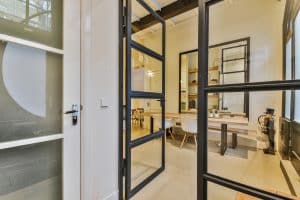 A thermal break is a strip of low-conductivity material (typically polyurethane or polyamide) embedded in the frame to stop heat transfer through the steel. Without a thermal break, iron would conduct outdoor heat into the house in summer and draw heat out in winter. With a thermal break, the frame behaves much more like a wood or fiberglass frame.
Double-pane glass with an argon or krypton gas fill and a Low-E coating dramatically cuts U-factor and SHGC. In New Orleans, Low-E coatings tuned for solar heat rejection matter most—they let in visible light while blocking infrared heat.
Compression weatherstripping on all four sides of the door, paired with an adjustable aluminum threshold and bottom sweep, seals the perimeter. Iron doors we install are typically rated at air leakage well below 0.30 cfm/ft², matching or beating fiberglass.
Multi-point locks pull the door tight against the weatherstripping at three or more points (top, middle, bottom). This compression improves the air seal—worth noting as a comfort and efficiency benefit, not just a security one.
| Door Type | Typical U-factor | Thermal Mass | Air Sealing |
|---|---|---|---|
| Hollow steel (big-box) | 0.35 – 0.50 | Low | Fair |
| Solid wood | 0.35 – 0.50 | Moderate | Good (when new) |
| Insulated fiberglass | 0.17 – 0.30 | Low | Very good |
| Custom iron (thermal break) | 0.20 – 0.35 | High | Very good |
Iron doors with thermal breaks land in the same range as insulated fiberglass on U-factor, with the added advantage of high thermal mass that smooths out daily temperature swings.
Louisiana’s energy load is dominated by cooling, not heating. The biggest energy win in a New Orleans home is keeping solar heat out of the envelope.
That means:
A qualified iron door fabricator will answer these without hesitation. For TurnKey Ironworks clients in New Orleans, we walk through every one of these during design review. For a broader context on iron doors, see our complete iron doors guide and our post on how long iron doors last.
TurnKey Ironworks designs every door with thermal performance in mind. Contact us for a free consultation, and we’ll walk you through the specs.
Yes. Modern iron doors with thermally broken frames, insulated Low-E glass, and compression weatherstripping have U-factors in the 0.20 – 0.35 range—comparable to or better than insulated fiberglass and wood doors.
The exterior surface of a dark iron door will warm in direct sun, but a thermally broken frame prevents that heat from transferring indoors. Lighter finish colors and solar screens further reduce surface heating on west-facing elevations.
Replacing a drafty or uninsulated front door with a thermally broken iron door can reduce air leakage and heat gain, which modestly lowers cooling bills. The bigger factor is overall envelope air sealing—the door is one piece of the system.
A thermal break is a low-conductivity material embedded in the iron frame that stops heat transfer between the indoor and outdoor faces. It’s what makes modern iron doors as thermally efficient as fiberglass.
In New Orleans, yes. Insulated Low-E glass cuts U-factor by roughly 40% compared to single-pane and blocks most solar heat gain while keeping visible light high. The upgrade typically pays for itself in five to eight years through cooling savings and comfort.
Most iron doors do not need storm doors. Adding a storm door can actually trap heat in front of the iron door and accelerate finish wear. Skip the storm door unless you have a specific reason (security screen, pet flap, etc.).
 Turnkey Ironworks